See also
 ECA Group is joining forces with iXblue and becomes Exail Learn moreECA Group is joining forces with iXblue and becomes Exail Learn more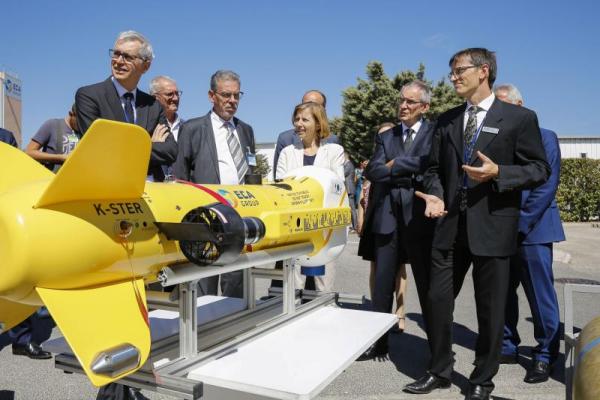
Published on Mer et Marine, September 2017
Read the PDF (French)
The French Minister of Defence, delivered the closing speech of the 15th edition of the Université d'été de la Défense, which took place this year in Toulon. Florence Parly announced in particular the decision to equip the French aerial drones for armaments. The minister also revisited the budgetary issue within her ministry, the threats to France and Europe, including North Korean missiles, and set the objectives of the next strategic review, which will lead to a new military programming law covering the period 2019-2025.
Here is the text of his speech in Toulon:
"Mr. President Jean-Jacques Bridey, Mr President Christian Cambon, General Officers, Ladies and gentlemen, dear friends, The Université d'été de la Défense is an important time in the life of our armies and the entire community of defence. A moment of encounter, dialogue and reflection. I am happy to be here in Toulon, to share this moment with you. At the beginning of our mandate, with a profoundly renewed national representation and when we are at the threshold of structuring decisions for our armies, this edition takes on a special importance. First of all, I would like to thank all the parliamentarians for coming in number. You thus mark your interest in defence policy and your unwavering attachment to women and men whom risk their lives every day to protect of our country and fellow citizens.
This Université d'été de la Défense was also able to take place under the best conditions thanks to the involvement of the armies and the entire Ministry. Here in Toulon, aboard the BPC Mistral, I would like to pay a particular tribute to the French Navy. Each of us was able to observe, during the demonstrations yesterday, the excellence of the Navy, of its men and women as well as the equipment they operate. The BPC also illustrates our navy's contribution to joint capabilities. The daily-basis ability of our three armies to operate together in the service of our country is one of France's assets we must maintain. This event comes at a crucial time for our country and its armed forces. French people have entrusted the elected President of the Republic and Government the mission to give our nation a new impetus and to protect it within a context of increased threats. The President has set a clear course for me, precise deadlines and new ways of dealing with these challenges. I am determined to fulfill this mission, and I know that the entire defence community will be committed to mobilize around these objectives. The strategic context, as you know, is not very satisfying. France is exposed to threats that are ever more numerous, more varied, more pernicious, near or far.
Terrorism is the first of these. In Sahel, in Levant, on the national territory or our allies' one, it strikes again and again. The victory against Daech seems certain, but it's when cornered that the enemy shows its most spectacular demonstrations. We saw it again this summer in Levallois and Barcelona. If Daech is being wiped out as a territorialized entity, the terrorists will always be there, they will reorganize themselves in another form and will act in other ways, as they have done in the past. Power strategies are also at work. All the great nations are strengthening their military capabilities; some have aggressive policies that challenge our interests and those of our allies. China, in the South China Sea, or Russia to the east of Europe, are demonstrating their power and intimidation. Thus, I shall go to Tallinn in Estonia tomorrow, to the outposts of Europe and the Atlantic Alliance; at a meeting of European defence ministers. I will visit our forces deployed as part of NATO's stronger presence. In Asia, North Korea's high-energy nuclear test and its multiple ballistic provocations this summer pose a threat to regional and international peace and security. They also demonstrate that nuclear and ballistic proliferation is an increasingly tangible danger; consider that Europe, much sooner than expected, is likely to be soon within range of Kim Jong-un's missiles; and the scenario of a slippage towards a major conflict can not be ruled out.
These very worrying developments remind us that we must never forget that we are for a long time to be exposed to the supreme risk. News and history, This centenary of the First World War, show that the security and stability of our societies are not acquired. This news also consolidates the need for France of a nuclear deterrent, which by its two components, whose renewal is expected in the decade to come, offers us its protection and a status as a great power.
Finally, new threats emerge. Cyber is one such example. The digital space offers immense opportunities; it also creates increasing vulnerabilities, of which we have probably only had a foretaste. Today, our phones can be diverted into microphones, data thefts threaten our national security, cyber attacks block stations and hospitals, or even jeopardize aviation security and maritime traffic safety. We must take these new threats into account, anticipate their evolutions and empower us to neutralize and combat them. And this, in a context where questions can weigh on the intentions of some of our key partners, making it even more necessary that we have a full autonomy of appreciation, decision and action. But everything is not so black and we must not succumb through reducing our strategic environment to a sum of risks and uncertainties; the new European impetus that the President of the Republic wishes to promote, the benefits of digital transformation, are all opportunities that our defence community must seize resolutely.
To carry out this reflection, to clarify the strategic choices our nation must make to prepare its defence tool by 2030, I asked Arnaud Danjean to conduct a strategic review; its conclusions, expected in early October, will be one of the foundations of the law of military programming that we are going to start, whose adoption is expected by the end of the first half of 2018. This MLP, which will run from 2019 to 2025, will have to address two major challenges, which are decisive for the security of our country: in the short term, to meet the pressing needs of our armies, departments and services, which face an unprecedented operational commitment and suffer the consequences in terms of equipment wear and pressure upon their personnel; in the medium and long term, to build the defence tool we will need to face the challenges of the 2030 world. In this uncertain and dangerous world, it seems to me that our defence tool, apart from preserving a complete army model needed to preserve our rank, should have four main characteristics:
agility, to anticipate and respond quickly to strategic and technological developments, in particular through increased efforts in the decisive area of intelligence, more responsive modes of engagement and a renewed process of equipment purchasing;
sustainability, in order to prevent the danger of exhaustion and decommissioning; the preservation of our strategic autonomy, especially in areas of sovereignty, where we must be able to act alone;
research, voluntarist and lucid, new cooperation, especially European, which will be for us a multiplier capacity and efficiency.
To implement this new vision, armies will have increased resources. Indeed, the President of the Republic has taken the historic decision to increase our defense effort: by 2018, the budgetary appropriations of the Defence mission will increase by 1.8 billion euros. This is a major shift from the increases already initiated in recent years: from 2016 to 2017, the budget increased by € 600 million, an appreciable effort. 1.8 billion in 2018 is three times more. This is the first step towards the target set by the President of the Republic of increasing the defence effort to 2% of GDP or 50 billion euros in 2025 on a like-for-like basis. This will raise the defense effort from 1.78% of GDP today to 1.82% next year. The pace of this increase will continue with an increase of 1.6 billion euros per year throughout the five-year period. This turning point is historic. For forty years, no financial effort in favor of the armies has been so important. Yet, strangely, many commentators have preferred to focus on the measures taken to manage public finances in 2017, thus obscuring the extent of decisions to increase our budget for 2018 and beyond. I would like to put things back in their proper place. We found on arriving a calamitous financial situation. The Court of Auditors has confirmed that controlling our public finances, which is an indispensable part of our national sovereignty, requires adjustment measures. The government decided on a number of savings for 2017, which affected all departments; the Ministry of Armies has logically made its contribution. No reduction is evidently painless, and those concerning our armies are no less painless than those concerning other public policies; but they should be relativized in the light of the overall effort made for defence. Out of a budget of € 32.7 billion, € 850 million of appropriations were canceled and € 643 million of new appropriations were opened. The cancellation of appropriations will in no way affect the functioning of our armies; they will focus mainly on cash flow measures and the lag of some programs. At the same time, these decisions make it possible to finance the additional costs associated with the operations. The means entrusted to my Ministry and of which we are all indebted to the French taxpayers are substantial and will be growing over the next few years. We must all together endeavor to make the best use of it in the service of the French people. To make the best use of it is, first of all, to constantly adjust our strategy and our means of defence to the evolution of threats.
On the national territory, this involves an overhaul of Operation Sentinel, which will be announced very soon. The operational contract for protection by the armed forces of the national territory will be preserved, but its modus operandi will make it more efficient and responsive. Faced with a diffuse but very real threat, the renovated Sentinel system will give our armies the advantage of uncertainty and will allow faster, better targeted efforts to scale, depending on the timing or the assessment of the threat for the protection of the French. In the external theaters, we will continue to carry out the necessary actions for the advanced protection of our territory and the stability of the countries concerned. Our efforts, alongside our partners, have had their effects, especially in the Levant, but there can be no question of lowering our custody, while reserving the possibility, here and there, of adjusting our level of commitment to opertaional developments. Adapting our defence tool also takes into account the evolution of technologies and what they imply in terms of military strategy to increase efficiency. Outside our borders, the enemy becomes more stealthy, more mobile, diluted in the vast expanses of the Sahel or hides among the civilian population. Faced with this, we can not remain static. Our modes of action and equipment must adapt to keep the lead time that is decisive to achieve our goals. It is in this spirit that I decided to launch the process of armament of our drones dedicated to intelligence and surveillance.
The surveillance drones bring to modern combat their discretion and their capacity increased operational duration on the zones of action. They reduce hupman risks. They have become indispensable tools in our operations in the Sahel, where our REAPERs are used to monitor, identify and track targets. But when it comes to treating these targets, today we must call upon other means, planes or helicopters of combat, whose strikes are sometimes guided by our surveillance drones. The success of the operation therefore depends on the availability and perfect coordination of several means, with deployment times in important areas, even though the opportunity to treat the target is often fleeting. These issues were perfectly identified and explained in the report of Senators Cédric Perrin and Gilbert Roger last May. In the future, with the decision I am announcing today, armed drones will permanently combine surveillance, endurance in discretion and strike capability at the most appropriate time. Thus, we gain in efficiency and limit the risk of collateral damage. This new use will also make it possible to optimize the use of aircraft, combat aircraft and their refueling or helicopters, faster, more powerful but also heavier in their implementation. I want in advance to refute possible amalgams and dispel any fears. No, an armed drone is not a killer robot. These are two systems that have in common. This decision does not change the rules on the use of force or respect for the law of armed conflict, and I remain committed to the respect of international law and our commitments to arms control and the preservation of civilian population in conflicts.
Indeed, the rules of engagement for armed drones will be strictly identical to those we already apply. Whether it is a Caesar cannon, a cruise missile, a Rafale: as with drones, if the operator is physically distant from the objective, the man is none the less at the heart of the fire's engagement. Concretely, this decision will concern initially the drones REAPER that we acquired in the United States. They will be equipped with precision-guided weapons. In the medium term, the future European drone, which we are carrying out studies in cooperation with Germany, Italy and Spain, will also be equipped with armaments. France is joining the group of nations that already have or are in the process of doing so: our American, British, German and Italian allies, as well as more than a dozen worldwide. This expansion of armed drones' possession confirms that this is a key capability of tomorrow's fighting, as was the armored vehicle or aircraft in their days. France can not pass by, under penalty of being degraded. Avoiding decommissioning, we will also achieve it by wearing a defence that goes beyond our horizon. I will fight for the Europe of defence. I have already spoken on this topic this morning, so I will only say that I will move forward with all the good wills on capabilities, institutions and operations. I will be voluntarist and pragmatic, with a single slogan: efficiency. I will also push our defence industry forward. It is one of the catalysts of the European defence and one of the engines of the French economy. We must continue to support the industry, preserve its key capabilities and know-how, and support our exports with all our energy.
And since we are today on a ship of the French Navy, I want to say that in the naval field in particular, I want to give our defence industry the means to develop strongly. That is why I am currently working on building an alliance between the French and Italian military naval industries in the field of surface vessels, with the ambition of becoming a world leader. This ambitious project advances, in close consultation with the industrialists concerned; I will have the opportunity to come back in the coming weeks. I also intend to place particular emphasis on promoting innovation, which is a decisive factor for our security and competitiveness. Let us think, for example, of the promises of artificial intelligence, robotics or quantum computing. It is therefore vital that innovation inspires the entire defence community to ensure the technological superiority of our forces on the ground in the face of current and potential adversaries who are increasingly skilled and inventive in the use of new technologies. Innovation will also make it possible to increase the efficiency of our human, financial and industrial resources. Finally, it will benefit from the creativity of our defence community.
This capacity of innovation, I wish it irrigates the whole Ministry. Much has been done for its modernization, but I still want to accelerate and accentuate this movement, so that the Ministry of Armies is at the forefront of innovation and digital transformation. In particular, I wish to review in detail the procedures and the means used to acquire the equipment needed by our armies. It is a question of better responding to these needs, of being more agile and responsive, of adapting better to changing technologies. We are fortunate to have an already powerful tool with the DGA and our defence industry. I saw it yesterday at La Garde, at ECA Group, underwater robotics technologies enable our Navy to have the best capabilities to fight against mines. These two companies, by their success in the civil markets, are also emblematic of the spin-offs of defence investment for our economy.
Sixty years ago, our engineers and industry demonstrated that they were able to respond to the challenges of the national community, to build a deterrent and to provide our country with leading-edge weapons. I have no doubt that we will be able to cope with the technological and industrial challenges of tomorrow. The new DGA and all the players in the defence industry have every confidence in me. Modernizing our defence tool also means improving the availability of equipment, particularly aeronautics, increasing the effectiveness of support, as close to the field as possible, and simplifying procedures. I will announce initiatives in all these areas in the near future. This modernization will not be achieved without extensive consultation and the mobilization of all actors will be necessary. Faced with all these challenges, I am fully aware of the commitment of our armies. I measure the efforts that have been demanded of all to allow France to intervene wherever its interests were threatened. Despite the difficulties, both in foreign operations and on the national territory, our soldiers show courage, dignity and self-sacrifice that I measure at each of my meetings with them. I want to pay honour to them here; and to show them my willingness to pay the utmost attention to their personal situation, working conditions, living conditions and those of their families.
The Ministry of Armies has always paid particular attention to its personnel; the most efficient equipment, the most intelligent plans, the most daring maneuvers are worthless without the men and women who design, support and implement them. It is an essential element of the effectiveness of our defence tool. With regard to recruitment, training, retraining, accommodation, housing, food, the armies and the services of the Ministry are doing their utmost to ensure that our soldiers have the living and working conditions their commitment deserves. What has been said in recent weeks about the fact that we are neglecting the issue of military status simply does not correspond to reality. However, we owe it to our soldiers to do everything possible to further improve this effort.
That is why I have made improving the status of staff one of my top priorities. The year 2017 has already been an occasion to take into account the overactivity of the military, especially in the area of compensation. The consequences of the Sentinel operation and external commitments, in particular, were taken into account. Concrete steps have been taken, in particular for the accommodation and feeding of Sentinel women and men, although there are still room for improvement. I also know that there are no strong soldiers without happy families. That is why, in accordance with the wish of the President of the Republic, I asked for a plan to accompany the families and improve the living conditions of the military. This comprehensive plan, which I hope will soon be implemented, is expected for finalization in October. It will be the subject of a broad consultation with the representative bodies and the associations.
I will also be particularly careful to ensure that the new payment balancing tool is efficient, reliable and efficient, to turn the page of mistakes made in the past. That is why I wanted to see for myself yesterday the degree of preparation of the teams in charge of this project by visiting the center charged with paying balances for the Navy. More modern, more effective ministry will be born and even better integrated into our national community. I want to strengthen the links between the armies and the Nation. This is not an incantation, it is an imperative. The French people live on a daily basis near military personnel in service, without necessarily measuring the extent of the missions and the risks that the armies assume every day for them. The civil and military world must know and understand each other. The creation of a National Service, wished by the President of the Republic will be a means of strengthening this link between our young people and the armed forces. Under the impulse of the President of the Republic and the Prime Minister, a reflection is initiated. I wish it wide, diverse, and rich. It should concern the entire national community and everyone should contribute to it. All will be associated, military, civil and parliamentary, of course. And this project goes far beyond the armed forces, it concerns other ministries, local authorities and actors of the civil society and the associative world. These stakes are high and I am happy to be supported by Geneviève Darrieussecq to raise them.
You now know the lines of my action. An action that I lead for the safety of the French people, for their freedom and security. I am also working for all those soldiers and civilians who struggle daily for our country, whether our soldiers in operations, all those who work for them, engineers and technicians, our intelligence officers. This action, finally, I will take it with you. Everyone will be involved and will be able to work for tomorrow's defence. A strong defence, proud, attentive to the men and women who bear it; a defence which inspires the respect of our allies and the fear of our enemies; an attractive, innovative defence, resolutely turned towards the future. I know the issues. I am determined to meet them. I do not underestimate the difficulties. I am ready to confront them. And I'm optimistic because I know this fight, the whole defence community, united, will deliver it with me. The President of the Republic, the Prime Minister and the National Representation have set ambitious targets at the service of the French people. We will know how to reach them.
 29 Jul. 2022
In February 2021, France initiated the renewal of its deterrent force by launching the design of...
Read More 16 Dec. 2020
TEST WEBINAR POST INTEGRATION LIVESTORM
Read More 2 Oct. 2020
ECA Group participates at the EURONAVAL exhibition, October 19th– 25th 2020. Meet us...
Read More
Meet ECA Group at PACIFIC 2019, on Thursday October 9 to discover its innovative degaussing and...
Read More 14 Oct. 2019
ECA Group provides support for French Navy's underwater measurement polygon, designed to...
Read More 30 Sep. 2019
ECA GROUP recently won two contracts to supply its new-generation ground robots, CAMELEON LG, to...
Read More
Meet ECA Group at DSEI 2019, on September 10th 2019 at 3.00 pm at the South Theater to discover...
Read More
Attend ECA Group conference at Marelec 2019, on October 22nd 2019 in Woods Hole, USA. Let's...
Read More 10 Jul. 2019
ECA Group was awarded by the Chilean Navy to upgrade the Steering Consoles...
Read More

